
How to Cold Email a Hiring Manager: The Complete Playbook
In March 2026, Robert Half surveyed more than 2,000 U.S. hiring managers and found that 67% say reviewing AI-generated applications has slowed their hiring process, with 20% reporting delays of more than two weeks. Eighty-four percent say their teams feel overworked as a direct result.
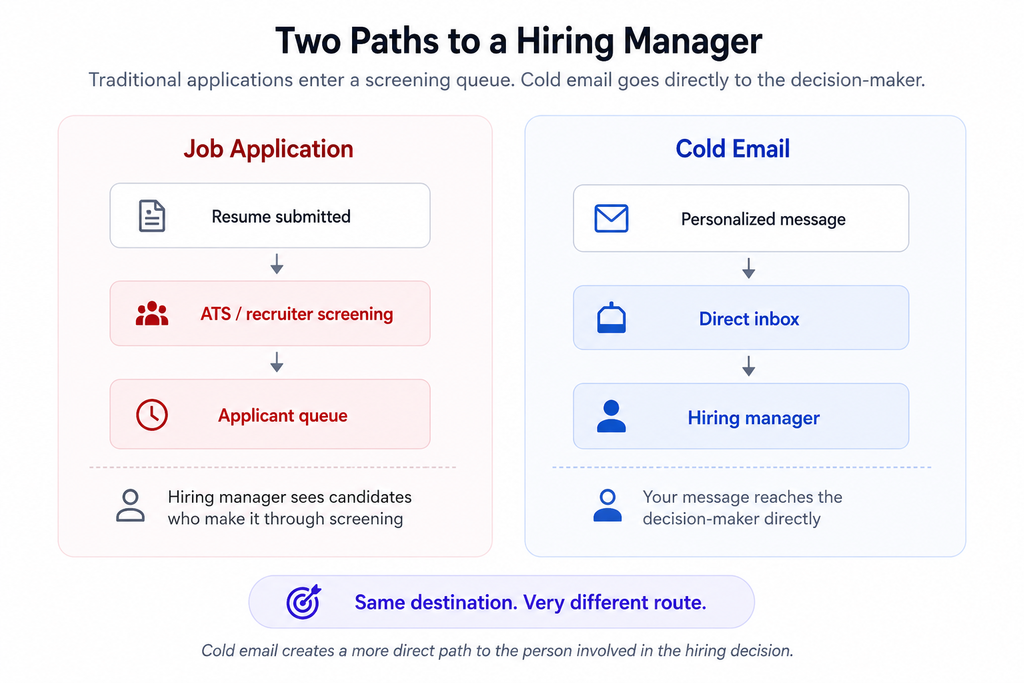
Here’s what most job seekers miss: the hiring manager’s direct inbox hasn’t absorbed that same flood. Almost everyone piled into the ATS queue. Almost nobody is sending a cold email to a hiring manager – a researched, personalized message that reaches the actual person doing the hiring, not the queue in front of them.
That gap is the strategy this guide covers – how to find the right hiring manager, write a cold email that gets read, choose a subject line that gets opened, decide between LinkedIn and email, and run a follow-up sequence that doesn’t wear out its welcome.
Key Takeaways
- Find and verify the right email before doing deeper research. Start with the hiring manager’s name, company domain, and common corporate email patterns.
- Use a simple five-part structure: subject line, opening hook, credibility, relevance, and a low-friction CTA. Keep the message under 150 words.
- Keep subject lines short and specific. Aim for 6-10 words and make the company or team context obvious.
- Follow up twice, then stop. Space your messages out and add something new each time.
- Protect the relationship. Contact one decision-maker at a time, disclose if you also applied, and treat a clear “no” as final.
- Cold email works best as a relationship-building channel. LinkedIn found that 70% of people hired in 2016 joined companies where they already had a personal connection.
Does Cold Emailing a Hiring Manager Actually Work?
It works because of who reads it. An application gets screened by someone whose job is narrowing the pile – looking for reasons to cut you. A cold email gets read by the person who actually decides, as a message from a human being rather than a record in a queue.
The broader hiring data supports the logic. LinkedIn surveyed nearly 16,000 professionals across 17 countries in 2017 and found that 70% of people hired landed their job at a company where they already had a personal connection. Hiring runs substantially on personal connection – and cold email is how you manufacture one when you don’t already have it.
The closest data available on candidates emailing decision-makers directly is a documented case study: a job seeker sent 38 cold emails to decision-makers and got 8 replies – a 21% reply rate – plus 3 interviews. Over the same stretch, 25 job-board applications produced zero interviews (onecoldemail.com, 2026). One campaign, not a benchmark, but it captures the pattern: the channel with fewer applicants produced all of the conversations.
There’s a second reason outreach outperforms its effort cost. A large share of job openings never get publicly posted – estimates commonly put it at 70-80%. Emailing the hiring manager is how you reach roles that never make it to a job board in the first place.
Cold email isn’t a guaranteed shortcut. It’s a channel almost nobody else is using well, aimed at a hiring process that still runs substantially on who you know – or who you can get to know.
How Do You Find a Hiring Manager’s Email Address?
This takes about three minutes per company, because most corporate addresses follow one of three patterns: firstname@company.com, first.last@company.com, or firstinitial.last@company.com.
Find the person on LinkedIn by title, build the likely address from their name and the company domain, then run it through a free verifier like Hunter.io or Email Checker before you write anything. When pattern-matching fails, press releases, “Team” pages, and engineering-blog author bios are the reliable fallback.
The one rule worth internalizing is about order of operations: verify deliverability before you research the person. The most common mistake at this stage is spending 30 minutes on someone’s background for an address that turns out to bounce.
If you’d rather skip the manual search and verification process, Frontrunners.io can identify relevant hiring managers and find their contact details for you.
For a deeper walkthrough, see our guide on how to find and verify a hiring manager’s email address, including manual methods and verification tools.
How Do You Write a Cold Email That Gets Read (and Gets Replies)?
One principle drives everything below: generic, non-specific outreach reads as a mail merge, and mail merges get ignored. Every element of the message should be something you could only have written to this person, at this company, this week.
The anatomy of an effective cold email has five parts:
1. Subject line (covered in the next section – skip it for now)
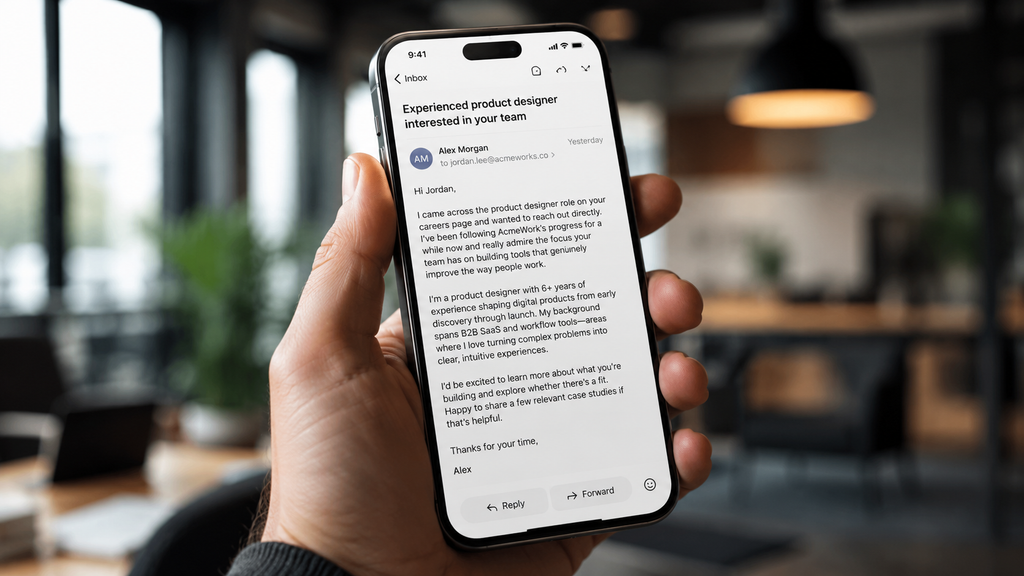
2. Opening hook. Your first sentence should reference something specific to the company – not “I’ve long admired your work” (generic) but “I noticed your team just launched the new API integrations – the product direction reminds me of work I did at [Company X].” Specificity is what separates a message that reads as a cold blast from one that reads as genuine outreach.
3. Credibility bridge. One sentence. Not your full resume – one relevant data point. “I led the growth function at [Company Y] from Series A to Series C” is enough. The goal is to give them a reason to keep reading, not to close them on hiring you.
4. Value statement. What do you bring to their current situation? This is the hardest part to write well. Don’t say “I’m passionate about your mission.” Say “Given what I know about your expansion into the enterprise segment, I think my background in customer onboarding at that scale is directly relevant.”
5. Low-friction CTA. Ask for a conversation, not a job. “Would you be open to a 15-minute call?” is far more likely to get a yes than “I’d love to be considered for any open roles.” One yes gets you in the door. The role conversation happens after.
Length matters more than most people realize. Keep the email under 150 words. Hiring managers are scanning dozens of messages. Every extra sentence is a reason to stop reading.
Want examples you can adapt? See our 10 cold email templates to send to hiring managers for different job-search situations.
What Should Your Subject Line Say?
The subject line is the entire first impression – get it wrong and the rest of the email doesn’t matter. Two rules do most of the work.
Word count: 6-10 words. Shorter than that reads as incomplete. Longer gets clipped on mobile. “Quick question about Acme’s engineering hiring” is seven words and reads as a real message, not a mail-merge subject line.
Specificity over cleverness. The subject line’s job is to earn the open, not to sell the email’s content. Three formulas that work reliably:
- Company signal: “Quick question about [Company]’s [team/initiative]”
- Question-based: “Is [Company] expanding the [function] team in Q3?”
- Mutual context: “Fellow [Alumni network/industry event] connection”
What doesn’t work:
- “Following up on my application” (implies ATS context, positions you as one of hundreds)
- “Interested in joining your team” (generic – applies to every job seeker sending this)
- “RE: [Job Title]” (deceptive thread hijacking – damages trust before the email is read)
- Anything with an exclamation mark or emoji (reads as mass email)
One reliable test: read the subject line aloud. If it could have been sent to 500 people simultaneously, it’s too generic.
What Do You Say When You Have No Connection at the Company?
No warm introduction? You can still move from cold to warm-adjacent in one sentence. The mechanism is a company signal – one specific, publicly verifiable detail that proves you actually looked before you wrote. A funding round and what it’s aimed at. A feature the team just shipped. Something the hiring manager published. A function you noticed them building out.
The difference isn’t charm, it’s research. A signal-led opener costs 10-15 minutes of reading before you write a word, and that cost is precisely what separates you from the generic pile – because almost nobody pays it.

That cost is also a useful filter in the other direction. If you can’t surface a single usable signal in 15 minutes, the company probably doesn’t belong on your target list yet – you don’t know enough about it to be persuasive, and no amount of rewriting fixes that.
LinkedIn Outreach vs. Email: Which Gets More Replies From Hiring Managers?
Neither channel is strictly better. They cover different gaps, which is why the strongest approach uses both in sequence.
Why LinkedIn tends to help. Context is instant. When a hiring manager opens a LinkedIn message, they can check the sender’s profile in ten seconds – work history, mutual connections, endorsements. Email requires them to go looking for that context separately, if they bother at all.
Why email tends to help. Space and schedule. LinkedIn messages have a character limit that makes it hard to deliver a substantive credibility bridge in one message. Email doesn’t. Hiring managers also tend to process email on their own time, not in response to a platform notification.
Why using both, in sequence, is worth trying. Each channel covers a gap the other has. A practical four-step structure:
- Day 0: Send the cold email
- Day 2-3: Send a LinkedIn connection request (no note, or a short one-liner: “Reached out via email – happy to connect either way”)
- Day 4-5: If they accepted the connection, send a brief LinkedIn message referencing the email
- Day 7: Second follow-up email (see next section)
The email does the persuading; the LinkedIn touch gives them the context to act on it.
How Many Times Should You Follow Up?
Two follow-ups after the initial message. Three touchpoints total, spaced roughly a week apart, each one adding something new rather than just nudging. That’s where most job-search coaches converge, and it’s the shape that respects a hiring manager’s inbox while still giving you more than one shot.
- Day 0: Initial cold email (subject line + full message, under 150 words)
- Day 7: Follow-up 1 (add a new piece of context – a relevant company observation, a result from your work, a question about their team)
- Day 14: Follow-up 2 (shorter – acknowledge you’ve reached out twice and offer an easy out: “Happy to connect whenever the timing is better”)
What to say in follow-ups is as important as the timing. “Just checking in” is not a follow-up – it’s a reminder that you’re still waiting. Each touchpoint should add something: a new data point about the company, a question about a specific team initiative, a result from a project you can now share. Treat the sequence as a series of additional reasons to reply, not a nudge campaign.
What Happens When a Hiring Manager Replies?
Most outreach guides stop at “send the email,” which leaves people unprepared for the part that actually decides the outcome. Replies come in four shapes, and three of them look like rejections while being nothing of the kind.
“Happy to chat.” Book it immediately, and book it soon – momentum is the whole asset here. Come with two or three specific questions about the team’s current problems, not a rehearsed pitch about yourself. You asked for a conversation, so have one.
“We’re not hiring right now.” This is the most common reply and the most misread. It’s not a no, it’s a timing statement – and you now have a warm contact at a company you want to work for. Reply once, briefly, thanking them and asking whether it’s alright to check back in a quarter. Then actually do it. The relationship is the asset; the opening is a question of timing.
“Send me your resume.” The weakest yes, because it moves you back toward the pile. Attach it, but don’t send a bare file – add two sentences connecting your background to whatever you referenced in the original email, so the resume arrives with a frame around it.
“I’ve forwarded you to our recruiter.” Genuinely useful, and also the point where most candidates get quietly dropped into the ATS queue they were trying to bypass. Thank the hiring manager, then email the recruiter directly within a day, referencing the hiring manager by name in the first line.
One more signal worth reading: no reply, but the person views your LinkedIn profile a day or two later. That’s interest without capacity. Keep them in the sequence.
Cold Email Etiquette: The Rules That Keep Relationships Intact
The line between persistent and annoying comes down to two principles: add new value at every touchpoint, and treat three unanswered, well-spaced, value-adding messages as your answer.
Everything else follows from a longer time horizon: you may want to work at this company in two years, and how you behave now decides whether that door is open.
Run one sequence per decision-maker. Emailing the hiring manager, the team lead, and the VP at once gets noticed the moment any two of them compare notes, and it reads as desperate rather than thorough. Disclose it if you also applied through the job board – hiding the application looks far worse than mentioning it, and naming it gives the hiring manager a trail to follow. And when someone declines, acknowledge it and stop. Reaching out again after a clear no is where persistence turns into harassment.

There are also moments when the right move is simply not to send: right after a company announces layoffs, when a posting explicitly asks candidates not to make direct contact, and when someone there has already told you no in the past six months.
How Do You Run This Without Burning Out?
Everything above describes one email to one person. The reason most people abandon outreach isn’t that it doesn’t work – it’s that they run it one company at a time, feel the silence, and quit around week two. Outreach is a portfolio, and it needs to be operated like one.
Keep a steady pipeline of outreach running. Don’t judge the strategy based on one or two companies. The more consistently you reach relevant hiring managers, the less any single non-reply matters. As sequences close out, keep adding qualified targets so your outreach continues without turning into a stop-start process.
Batch by activity, not by company. The instinct is to take one company all the way from research to send, then start the next. That’s the slowest possible order, because you pay the mental setup cost five times. Research five companies in one sitting, draft five emails in the next, send them in a third. The work gets faster and the writing gets better, because you’re comparing five openers against each other instead of judging one in isolation. If you’re using Frontrunners.io, much of that can be handled automatically instead.
Give it a weekly rhythm. A workable shape: research early in the week, send mid-week mornings when inboxes are being actively worked rather than triaged, and run follow-ups on a fixed day so they never require a decision. The point isn’t the specific days – it’s that a repeating schedule removes the daily “should I send today?” question that quietly kills most campaigns.
Track four columns, not fourteen. Contact, date sent, next touch date, status. A spreadsheet is enough. The elaborate CRM is procrastination in a respectable costume.
Set the expectation correctly. Most of these emails will not get a reply, and that is the normal operating state of the channel, not evidence that you’re doing it wrong. You are not running a conversion funnel; you’re trying to start a handful of real conversations with people who can hire you. A campaign that produces three genuine conversations out of forty emails has worked.
Start Your Outreach Today
Frontrunners automates the research-heavy steps: identifying the right hiring manager at each target company, finding and verifying their email address, and generating a personalized outreach message based on your resume and the company’s context. You handle the relationship. The platform handles the legwork.
→ Start your outbound job search with Frontrunners
Frequently Asked Questions
Yes – because it reaches a person directly rather than a queue, which matters more now that AI-generated applications have slowed ATS review to a crawl. It also targets the mechanism hiring actually runs on: 70% of 2016 hires happened at companies where the candidate already had a personal connection (LinkedIn, 2017). Cold email is how you create that connection when you don’t already have one.
Use LinkedIn to identify the person by title, then verify their email with Hunter.io’s domain search or a free email pattern tool. Most corporate emails follow firstname@company.com or first.last@company.com. Once you have a candidate address, run it through a deliverability checker before sending. Frontrunners.io automates this entire workflow.
No – when it’s researched and respectful, it reads as initiative rather than desperation. Reference something specific about the company or role, keep the message under 150 words, and if you get a decline, acknowledge it gracefully and move on. Treat it the same way you’d treat any professional first contact.
Use 6-10 words with a company-specific reference or a question, such as “Quick question about [Company]’s [team/initiative].” Avoid anything that reads like mass outreach – exclamation marks, emoji, “Interested in joining your team,” or a fake “RE:” thread.
Under 150 words. Hiring managers are scanning many messages at once, and every extra sentence is a reason to stop reading. Five strong, specific sentences beat two rambling paragraphs. Get to the specific value point immediately, then stop.
You can still reach out – this is sometimes called speculative or hidden-market outreach, and it’s a legitimate strategy, not a long shot. The same research-and-specificity principles in this guide apply; you’re just making the case for a role that doesn’t officially exist yet.
You can do both, but lead with the email. Applying first labels you as one of hundreds of applicants before the hiring manager has any context for who you are. Email first, then mention in your message that you’ve also submitted an application – this gives the hiring manager a clear next action and signals you went beyond the standard process.
Two follow-ups after the initial message – three touchpoints total – spaced roughly a week apart, each adding something new. After three unanswered, well-spaced messages, treat the silence as your answer and move on.
Conclusion
The single most important thing to take away: cold email is a channel where research and specificity carry more weight than volume, precisely because almost nobody executes it well. A job board application takes two minutes and lands in a queue with hundreds of others. A well-researched cold email takes real effort – and reaches an inbox that isn’t nearly as crowded.
As AI-generated applications keep slowing down hiring teams’ ability to review the ATS queue, the hiring manager’s inbox stays relatively open. That gap is the opportunity. Start using it this week.
Sources:
- LinkedIn, “Eighty percent of professionals consider networking important to career success” (2017 survey, 15,905 members, 17 countries)
- Robert Half, “Robert Half survey: 67% of HR leaders report AI-generated applications are slowing hiring,” March 10, 2026
- onecoldemail.com, “Case Study: How a Senior Professional Broke Into a New Industry Using Cold Outreach,” April 2026